Keep Young, and Grow Up
Last and First MenKeep Young, and Grow Up is the central expression of the prophet’s mature teaching: preserve the freshness and responsiveness of youth, but do not mistake arrested development for vitality. Its importance lies in the reversal it demands of his Patagonian followers. They had embraced youth as an end in itself; he insisted that genuine youth must lead onward, into greater skill, insight, and freedom from the compulsion to win.
Origins in the Youth Movement
The prophet, born to shepherd parents among the Southern Andes, first became known as the leader of a romantic youth movement. He urged young people to set an example to their elders, live without being daunted by convention, enjoy themselves, work hard but briefly, and remain loyal comrades. His early maxim, “Let us keep young,” spoke directly to Patagonians who feared their people’s apparent senescence. He taught that no one need grow old in spirit if they kept the soul awake, remained open to rejuvenating influences, and resisted senility.
He gave this ideal a distinctly social and intimate meaning. The delight of soul in soul, he taught, could renew both lover and beloved; if Patagonians appreciated one another’s beauty without jealousy, the race itself might become young again. The expanding Band of Youth therefore understood its mission as the rejuvenation of humanity. Yet the prophet’s own example made the message seem more than an aspiration: while his contemporaries showed signs of senescence, he remained physically young and unusually vigorous, and his many offspring were counted in hundreds.
The Mature Correction
The prophet’s youthful vitality was intellectual as well as physical. After a period of exuberant love-making, he turned to work and meditation. At twenty-five, when many Patagonians had settled into fixed habits of thought, he was still wrestling with successive waves of ideas. He did not deliver his mature gospel until he was forty, still in his physical prime. It proved difficult for most of his people to understand: it arose from their culture, but from a level of vitality few could reach.
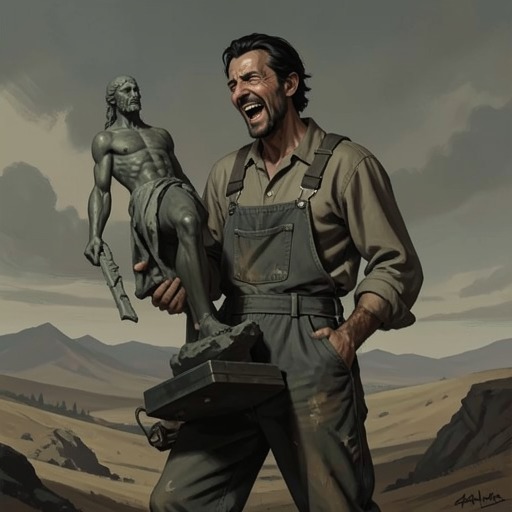
During a ceremony in the capital’s supreme temple, worshippers lay prostrate before the image of the Creator. The prophet walked to the altar, looked at the congregation and the idol, laughed, and slapped the image. His rebuke turned the slogan of his earlier movement against its devotees: “For God's sake, grow up!” Keeping young, he explained, meant remaining supple and keen; growing up meant rising into finer skill in the actions of life, not sinking into stiffness or disillusion. The two demands were complementary. Without growth, the cult of youth became a childish imitation of the very vitality it sought to preserve.
Life as a Game
The mature teaching extends beyond personal development into an account of how to live. Life is a game that must be taken seriously, but not treated as though victory were its only purpose. A good player strains every muscle to win while caring more for the game itself; that distance from victory makes better play possible. The prophet contrasts this attitude with that of barbarians competing against a Patagonian team: they become savage when losing and boastful when winning, destroying the beauty of the contest in either case.
He applies the same distinction to religion. The worshippers’ solemn gestures and vows resemble attempts to flatter or bargain with the umpire of life. The prophet acknowledged that he, too, had once cursed that umpire; later, he learned to laugh at the false image people had set up in its place, and finally to laugh with the umpire at his own earlier failure to grasp the spirit of the game. The correction is therefore not simply a denunciation of his followers. It includes his own former misjudgment and replaces resentment or supplication with a more lucid participation in life.
Misreading and Historical Reception
The Patagonians turned the prophet into a sacred figure called the Boy Who Refused to Grow Up. In the legend, his vitality was concentrated beyond measure, and he became divine as the outcome of humanity’s effort. The cult preserved the promise of a young-hearted future, but also feared that the race would inevitably grow old and die. Its followers praised the prophet while missing the distinction that his mature message made indispensable: youth is not refusal to develop. The wider Patagonian tragedy was not merely senescence but arrested growth, which left the people longing to become young again without recognizing growth into a more far-seeing vitality as youth’s fulfillment.
The surviving past repeatedly changed meaning as later peoples encountered it. During the First Dark Age, the First human species engraved the Swastika on crude stone tools; a symbol that had begun as an image of an aeroplane diving to destruction, and a sign of rebellion against Gordelpus and the State, was recast by later generations as the mark of a divine ancestor and a lost golden age. Much later, Patagonian archaeologists found durable metal printing plates beneath a shattered pylon in China and reconstructed the history of the earlier civilization. The discovery revealed both its brilliance and its eventual triumph by the irrational; it divided the Patagonians between those who rejected the new learning and those who faced it. This history gives the prophet’s correction a broader resonance: inherited ideals, like inherited relics, can survive while their meaning is distorted.
When the Second Men later reconstructed the Siberian Stone Library, they valued its tablets chiefly as historical testimony to an earlier mind. A record of the Life of the Divine Boy preserved the prophet’s final words, and the Second Men recognized in them an intuition familiar from their own experience. In the far-future account, The Last Men likewise make the effort to know and love minds from the human past. Across these recoveries, the teaching’s enduring force rests on a distinction easily lost and repeatedly rediscovered: fidelity to life requires both the freshness to begin again and the maturity to keep growing.